
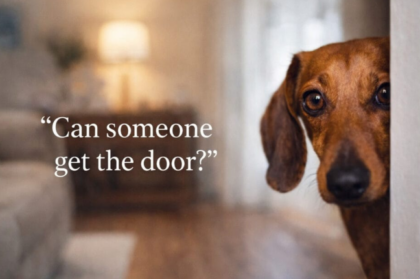
The Door Guest Tail Method: How to Keep Your Dog Calm When Guests Arrive
If your dog transforms the moment the doorbell rings, you’re not alone.
Front door crowding.
Doorway tension barking.
Jump greetings that escalate in seconds.
For many modern dog parents, guest arrivals are one of the most consistently stressful moments of the day.
The good news? Most door chaos isn’t disobedience — It’s repetitive excitement without structure.
At Tail Wisdom, we use a calm, repeatable framework called the Door Guest Tail Method™ — designed for real homes, real schedules, and real dogs.
Why Door Greetings Go Sideways
From your dog’s perspective, the front door is a pressure cooker.
Common triggers stack quickly:
- Frequent ringing throughout the day
- Sudden early morning visitors
- Video doorbell alerts chiming unpredictably
- Excited holiday or party hosting energy
- Guests leaning in for enthusiastic greetings
What looks like “bad behavior” is usually:
- anticipation
- startle response
- barrier frustration
- social over-excitement
Without a clear job, dogs default to what works: rush, bark, jump, repeat.
What Is the Door Guest Tail Method?
The Door Guest Tail Method is a structured calm-entry routine that teaches your dog:
- where to go
- what to do
- how to regulate
before the door ever opens.
Instead of managing chaos after it starts, we lower the temperature before guest arrival.
Think of it as: Calm is trained upstream — not negotiated at the doorway.
The Calm Guest Routine (Step-by-Step)
This is the core system Tail Wisdom families use.
Step 1: Prep Before the Door Opens
Before you touch the handle:
- leash on if needed
- treats ready
- designated “place” cleared
- your own energy steady
This single pause prevents most front door crowding from escalating.
Step 2: Give Your Dog a Job
Your dog should never freelance the doorway.
Common options:
- Place cue (bed or mat)
- Sit at distance
- Behind-gate position for excitable dogs
This directly reduces:
- doorway tension bark
- doorbell panic
- jump greeting attempts
Structure lowers uncertainty.
Step 3: Practice the Doorbell (Yes, Intentionally)
Many households skip this — and it shows.
A proper doorbell training session should include:
- low-volume practice rings
- paired rewards for calm behavior
- gradual realism over time
Short, calm doorbell practice reps build enormous stability.
Especially important if you have:
- frequent deliveries
- smart doorbell alerts
- busy households
Step 4: Control the Opening Moment
The door only opens when your dog is:
- below threshold
- holding position
- not vocalizing
If excitement spikes, the door closes again.
This teaches your dog: Calm behavior makes the door work.
Step 5: Coach Your Guests (Quietly but Clearly)
Many regressions happen here.
Before guests enter, give simple guidance:
- no leaning over the dog
- no immediate hugging
- ignore jumping attempts
- greet calmly first
This prevents classic visitor hug chaos and keeps greetings smooth.
Real-Life Situations (And How to Handle Them)
Because real homes are rarely quiet and predictable.
Early Morning Visitor
Dogs are often more reactive when just waking.
Adjustment:
- slower pace
- softer doorbell volume if possible
- extra distance from the door
Morning nervous systems need more buffer.
Frequent Ringing Households
If your doorbell goes off all day:
You don’t need perfection every time — you need patterns.
Focus on:
- 1–2 intentional training reps daily
- management during high-traffic periods
- reinforcing calm check-ins
Consistency beats intensity.
Doorbell with Video Alert
Smart doorbells add a new layer of unpredictability.
Dogs often react to:
- chimes
- phone sounds
- recorded voices
Training tip: include the video alert sound in your doorbell practice sessions so it becomes background noise instead of a trigger.
Holiday or Party Hosting
High-energy gatherings change the entire picture.
During parties:
- increase distance from the door
- use leash or gate proactively
- shorten greeting expectations
- schedule decompression breaks
Management is not failure — it’s advanced handling.
The Classic Dog Jump Greeting
Jumping is usually:
- social excitement
- proximity seeking
- reinforcement history
The fix is not punishment — it’s structured greeting access.
Reward:
- four-on-the-floor
- calm approaches
- disengagement after greeting
Over time, calm becomes the faster path to social access.
If Things Still Go Sideways (Recovery Protocol)
Even well-trained dogs have moments.
After a overly excited guest arrival:
- Create space
- Lower stimulation
- Offer a simple known behavior
- Allow full nervous system reset
Avoid:
- rapid repeated door exposures
- emotional corrections
- immediate re-triggering
Recovery is part of the method — not a failure of it.
Quick Start: The Calm Door Checklist
Before your next guest arrival:
✓ Treats ready
✓ Place cue prepared
✓ Doorbell practiced this week
✓ Guest instructions given
✓ Recovery plan in mind
Small preparation creates outsized calm.
The Bottom Line
Most door chaos isn’t about stubborn dogs.
It’s about:
- unclear expectations
- stacked triggers
- and greetings that move too fast for regulation
The Door Guest Tail Method works because it respects how dogs actually process arrivals in modern homes.
Calm is not luck. It’s designed.
For more calm-first routines for real-life dog homes, explore the full Tail Wisdom Method Library.